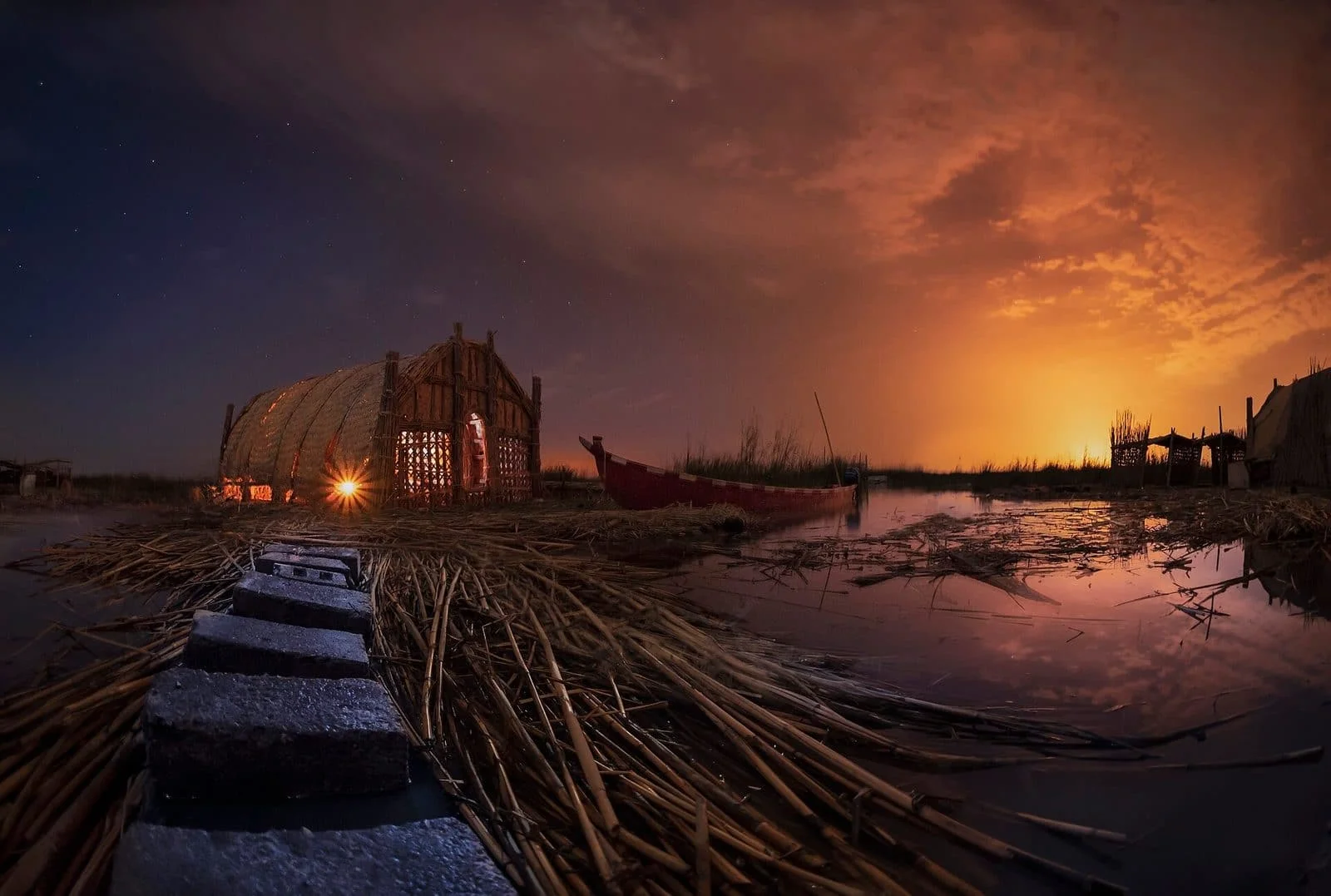
Gliding through the reed channels of Chibayish as the first light of morning turns the water to gold, a glimpse of the Iraq that guidebooks cannot prepare you for.
Before Dawn on the Water
The mashoof glides without a sound. Ahead of us the reeds of the Mesopotamian Marshes rise higher than a man on horseback, and the first light of morning turns the channels to hammered gold. This is the Iraq that guidebooks cannot prepare you for.
The Marsh Arabs, the Ma'dan, have built their mudhif reed houses here for five thousand years, exactly as their ancestors did. To sit inside one, under its vaulted arch of bundled qasab reeds, with tea being poured over cardamom, is to understand that civilization did not merely begin here. It still lives here. The marshes cover approximately 20,000 square kilometres of southern Iraq, fed by the Tigris and Euphrates rivers. They are the largest wetland ecosystem in the Middle East, and one of the most important in the world. In 2016 they were inscribed as a UNESCO World Heritage Site, recognized for their outstanding universal value as a cultural landscape that has been continuously inhabited for millennia.
The Mudhif
The mudhif is the traditional reed house of the Ma'dan, built entirely from qasab reeds that grow abundantly in the marshes. The construction technique has not changed in thousands of years. Bundles of reeds are bent into parabolic arches, then woven together to form a vaulted hall that can be fifteen metres long and five metres high. The interior is cool in summer and warm in winter. The mudhif is not just a house. It is a guest house, a community meeting place, and a symbol of Ma'dan identity. When a traveler enters a mudhif, the host serves tea and food. The hospitality is automatic, unconditional, and deeply felt. UNESCO recognized the mudhif building technique as part of Iraq's Intangible Cultural Heritage in 2016.
The Rhythm of Marsh Life
A day in the marshes unfolds slowly, and that is the point. Water buffalo wade past the house at dawn. Fishermen repair their nets on the platforms. Children row to school in canoes. By late afternoon the light turns amber, and the water becomes a mirror of the sky. The Ma'dan fish for carp, catfish, and barbel using traditional nets and traps. They cultivate rice in the shallow waters. They keep water buffalo, whose milk is used to make ghee and yogurt. The rhythm of life follows the seasons: high water in spring and summer, low water in autumn and winter. The marshes are not a museum. They are a living ecosystem where people have adapted their entire way of life to the water.
"We did not come to the marshes to see a place. We came to see how people live in a place that time forgot to ruin." - a traveler, Chibayish
The Ziggurat, an Hour Away
Forty minutes from the marsh village lies the great Ziggurat of Ur, the stairway to heaven built by Ur-Nammu around 2100 BCE, and the traditional birthplace of Abraham. It rises out of the desert like a mountain made by hand. Stand at its base at sunset, and the seven thousand years between you and the Sumerians collapse to nothing. The juxtaposition is striking: the marshes, where civilization still lives in reed houses and fishing boats, and the ziggurat, where civilization first organized itself into cities and temples. Both are within an hour of each other. Both tell the same story from different angles.
When to Go
October to April is the sweet season: mild days, cool nights, and the water high enough to reach the deepest channels. The expeditions from our Mesopotamian Marshes itinerary time the paddles for dawn and dusk, when the birds are loudest and the light is softest. The marshes are home to over 200 bird species, including the Basra reed warbler, found nowhere else on earth. Summer brings extreme heat (above 50°C) and the water recedes, making navigation difficult. The best months are November through February, when the temperature is comfortable and the birdlife is at its peak.
Practical Notes
- Access: The marshes are approximately 3 hours from Basra by car. The Mesopotamian Marshes tour includes transport from Basra or Nasiriyah. The Deep Sumer and Anbar tour also visits the marshes as part of the southern Iraq itinerary.
- Accommodation: Basic guesthouses in Chibayish village. The mudhif experience is included in the Marshes tour. Do not expect luxury. Do expect authenticity.
- What to bring: Sunscreen, hat, insect repellent, camera. The light in the marshes is extraordinary, especially at dawn and dusk.
- Combine with: The Ziggurat of Ur (40 minutes), the city of Basra (3 hours), and the southern marshes circuit. All included in the Mesopotamian Marshes and Deep Sumer itineraries.