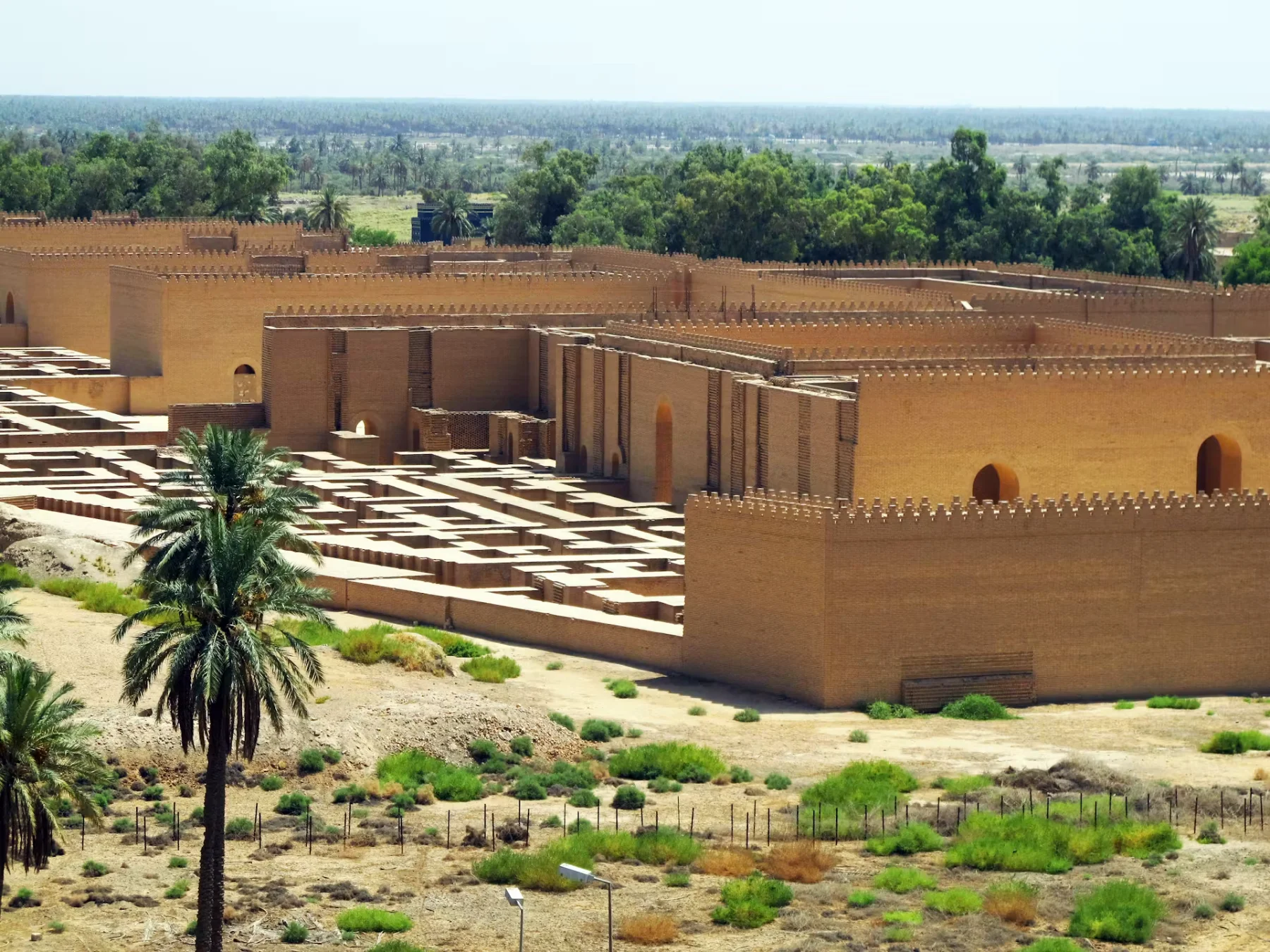
Two and a half thousand years after Nebuchadnezzar built it, the walls of Babylon still rise from the Iraqi plain. Saddam's palace stands on the hill above.
The Walls That Held an Empire
You see the walls before you see anything else. They are not tall in the way a modern building is tall. They are massive in the way that only ancient things can be massive, built from millions of sun-dried mud bricks, each one stamped with the name of Nebuchadnezzar II in cuneiform. The outer wall was six kilometres around. The inner wall was three kilometres. Between them ran a moat filled with water from the Euphrates. This was the most fortified city in the ancient world, and it was built to look like it.
Nebuchadnezzar II ruled the Neo-Babylonian Empire from 605 to 562 BCE. After defeating the Assyrians at Nineveh in 612 BCE, Babylon became the most powerful city on earth. Its population may have exceeded two hundred thousand in the inner city alone, perhaps the first city in history to do so. The suburbs could have sheltered a quarter of a million people. The total area was approximately 850 to 975 hectares. This was not a city. It was a statement.
The Ishtar Gate
The entrance to Babylon's ritual and political center was the Ishtar Gate, one of five city gates, and the most magnificent. Built by Nebuchadnezzar II around 575 BCE, it was constructed of brilliantly glazed bricks in brilliant blue, molded in relief to depict hundreds of dragons, lions, and aurochs. The dragon symbolized Marduk, the city god. The lion symbolized Ishtar, the goddess of love and war. The bull symbolized Adad, the weather god. The animals were arranged in alternating rows, their colors, blue, yellow, white, black, still vivid in the reconstructed version that stands in Berlin's Pergamon Museum.
The reconstruction in Berlin, assembled from fragments excavated by Robert Koldewey's team between 1899 and 1917, is impressive but deceptive. Less than twenty percent of the reconstructed gate consists of original Babylonian bricks. The gaps were filled with modern glazed bricks produced by three ceramic manufacturers near Berlin. The real Ishtar Gate, or what remains of it, stands at the site in Iraq: the earlier, unglazed construction phase of the gate's foundations, made of molded relief bricks, preserved and visible. A modern replica gate stands nearby for visitors. Since 2010 the World Monuments Fund has collaborated with Iraqi authorities to conserve the remaining Iraqi remains.
The Lion and the Palace
Near the northern end of the Processional Way, the grand ceremonial avenue decorated with glazed brick lions that led to the Ishtar Gate, stands the Lion of Babylon. A black basalt sculpture approximately 2.6 metres long and 1.95 metres high, weighing about twelve tons, it depicts a striding lion attacking a reclining human figure. Saddle-like marks on its back suggest it once supported a figure of the goddess Ishtar. The lion's origin is debated. Previously attributed to Nebuchadnezzar II, most scholars now believe it is of Hittite origin, made during a Hittite occupation or sack of Babylon in 1595 BCE. It remains in situ. It appears on Iraq's 25,000-dinar banknote.
The Hanging Gardens, if they existed, were one of the Seven Wonders of the Ancient World. Classical sources describe terraced gardens rising above the city, irrigated by a system of screws and channels that lifted water from the Euphrates. Some scholars believe the gardens were actually in Nineveh, built by the Assyrian king Sennacherib. Others believe they were in Babylon, built by Nebuchadnezzar II for his wife Amytis, who missed the green hills of her native Media. No archaeological evidence has been found at Babylon. The debate continues.
Saddam's Palace on the Hill
And then there is the palace. Saddam Hussein began building it around 1986, during the Iran-Iraq War, on a man-made hill created by demolishing the village of Qawarish. The bricks are inscribed: "the rebuilding of the great city of Babylon was done in 1987." Saddam imagined himself as the modern reincarnation of Nebuchadnezzar. The slogan was: "Nebuchadnezzar al-ams, Saddam Hussein al-yawm." Yesterday Nebuchadnezzar, today Saddam Hussein. The palace was built in the style of a Mesopotamian ziggurat, with marble floors, grand staircases, intricately carved doorways, chandeliers, and ceilings decorated with date palm designs. It covered an area large enough to fit five football pitches. Saddam's initials were carved into the stone facade. Bricks were stamped with his name in imitation of Nebuchadnezzar's practice.
From Saddam's bedroom balcony the ruins of ancient Babylon fill the view. The Euphrates, which once supplied the moat that protected the city, stretches to the horizon. Today the palace is abandoned, covered in graffiti, shattered windows, walls covered in drawings and writings, shards of chandeliers on the floor. US forces used it as a headquarters from 2003 to 2011. Plans to convert it into a museum or broadcasting center were never realized. It is open to visitors but essentially neglected, a dictator's monument that has become, against his intentions, a monument to the transience of power.
Babylon Today
Babylon was inscribed as a UNESCO World Heritage Site on 5 July 2019, at the forty-third session of the World Heritage Committee in Baku, Azerbaijan. The inscription recognized the site's outstanding universal value as a testament to one of the most influential civilizations in human history. The site is located about 85 km south of Baghdad, near the city of Hillah in Babil Governorate.
What visitors see today: the reconstructed Ishtar Gate replica, the Processional Way foundations, the Lion of Babylon, the remains of the Southern Palace, the Northern Palace foundations, the Marduk Temple site, the Etemenanki ziggurat foundations (the inspiration for the biblical Tower of Babel, approximately 91 metres tall in its original form, with a square base of 91 by 91 metres), and Saddam's palace on the hill. The site is vast. A full visit takes three to four hours.
Practical Notes
- Access: Babylon is approximately 85 km south of Baghdad (about 1.5 hours by car) near Hillah. The Mesopotamia Odyssey includes Babylon as a day trip from Baghdad. The Ziyarat and Heritage tour visits Babylon en route from Karbala to Baghdad.
- Entry fee: IQD 25,000 for foreigners, IQD 3,000 for Iraqis.
- Best time: Morning or late afternoon. The site has little shade. Avoid midday in summer.
- Combine with: Saddam's palace is included in the same ticket. Allow extra time to climb the palace hill for the panoramic view.