Where the Tigris bends through northern Iraq, a city that was almost destroyed is building itself again, one church, one mosque, one narrow street at a time.
The Minaret That Leaned
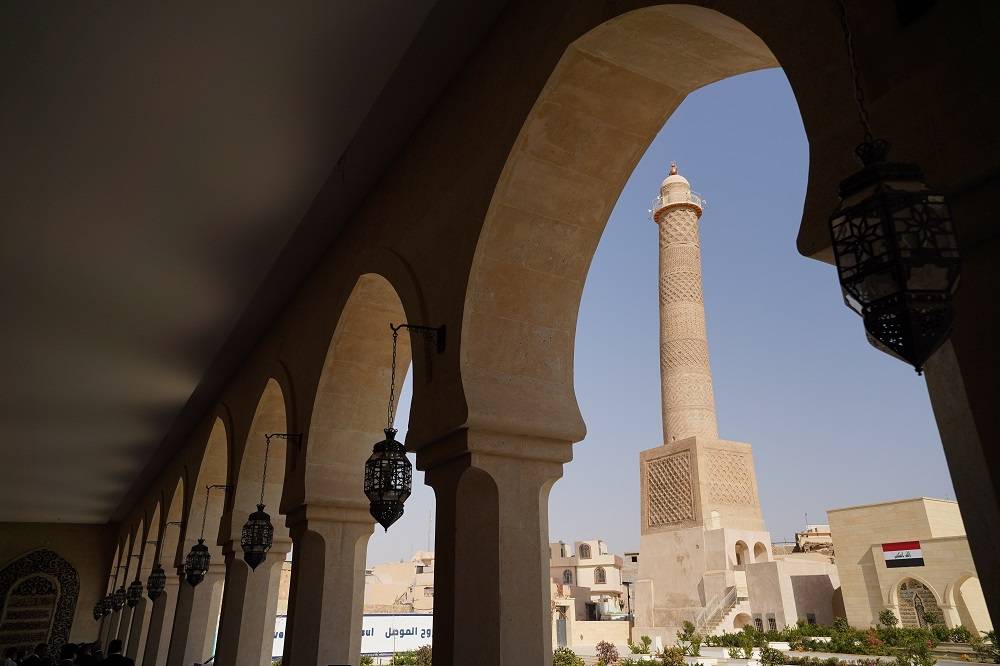
For eight hundred and forty-five years the Al-Hadba Minaret leaned over the city of Mosul. Built in 1172 by Nur al-Din Zangi, the cylindrical shaft rose forty-five metres above the Great Mosque of al-Nouri, its surface decorated with seven bands of ornamental brickwork in complex geometric patterns. The lean began by the fourteenth century. Differential settlement of the foundation, earthquakes, and in the 1980s bombing during the Iran-Iraq War broke underground pipes causing leaks that worsened the tilt by forty centimetres. At its worst the lean was approximately nine degrees from vertical, the top offset two and a half metres horizontally. It appeared on Iraq's 10,000-dinar note. It was the symbol of Mosul.
In June 2017, during the Battle of Mosul, ISIS destroyed the mosque and the minaret, blowing them up as Iraqi forces closed in. ISIS leader Abu Bakr al-Baghdadi had declared the caliphate from this mosque in 2014. The destruction was deliberate, a final act of erasure before defeat. Residents formed a human chain to prevent the complete collapse of the remaining base.
Revive the Spirit of Mosul
The reconstruction of the Al-Nouri Mosque and Al-Hadba Minaret is the centerpiece of UNESCO's "Revive the Spirit of Mosul" project, funded by a $50.4 million pledge from the United Arab Emirates in April 2018. The minaret was rebuilt entirely in brick masonry, a technique not used for centuries, leaning by special positioning of brick rows. Experts from the Leaning Tower of Pisa were consulted. A survey showed ninety-four percent of respondents wanted it restored exactly as it was. The mosque and minaret reopened in 2024. The square base of the original minaret was preserved as a memorial to ISIS victims.
Nearby, the Al-Tahera Church, a Syriac Catholic church more than two hundred and fifty years old, was also fully rebuilt by UNESCO with UAE funding. Pope Francis prayed here during his 2021 visit to Iraq, the first papal visit to the country. The Dominican Convent of Our Lady of the Hour, built in 1866 in Roman-Byzantine style, received Iraq's first belltower in 1880, funded by Empress Eugénie, wife of Napoleon III. Its clock faces were stolen by ISIS. Restoration was completed in April 2024.
Prophet Yunus, What the Mosque Revealed
The Prophet Yunus Mosque stood on a hilltop in Mosul's Old City for centuries. A Christian monastery attributed to the patriarch Hnanisho existed on the site first. In 1365 the ruler Jalal al-Din Ibrahim al-Khatni demolished the monastery and built a Sunni congregational mosque, claiming to have discovered the grave of the prophet Jonah, Yunus. On 24 July 2014 ISIS destroyed the mosque with explosives. ISIS stated the mosque "had become a place for apostasis, not prayer."
After liberation in March 2017 a tunnel system approximately one kilometre long was found beneath the ruins. Inside: Neo-Assyrian palace ruins, cuneiform inscriptions from the reign of Esarhaddon, and ruins attributed to the palace of Sennacherib, who died in 681 BCE. In 2025 a six-metre lamassu, the largest ever discovered, was uncovered in the throne room. The mosque was inaugurated on 3 April 2026, hosting its first Friday sermon and prayer in years, and its first Eid Al-Adha prayers in May 2026.
The discovery beneath the mosque is a reminder that Mosul sits on layers of civilization. Assyria is below. Islam is above. The city has always been a palimpsest, a manuscript written over, erased, and written over again.
The Old City, What Remains
The Old City of Mosul sits on the right (west) bank of the Tigris River. Before 2016 it was a dense labyrinth of narrow, winding streets and alleyways with buildings dating back to the Umayyad period, the eighth century. The city was divided into 251 neighbourhoods, or mahalas, with 91 on the right bank. The traditional Mosul house was an inward-looking design: rooms organized around a central open courtyard, with all windows facing inward, isolated from the outside. Privacy was paramount. Reaching the courtyard required passing through a chain of intermediate spaces and an indirect entrance. The houses were built with local marble columns, stone and brick construction, pointed arches, and iwans, vaulted halls open to the courtyard.
The Battle of Mosul (2016 to 2017) devastated the Old City. An estimated one million citizens were displaced. Most traditional houses were damaged or destroyed. ISIS used the narrow streets as defensive positions, and coalition and Iraqi forces responded with heavy bombardment. The residential fabric, centuries of accumulated architecture, was reduced to rubble in months.
What remains is a city rebuilding in three registers: faithful reproduction of the original, hybridization of old and new, and modern renewal. UNESCO has restored key landmarks, but most residential reconstruction is individual effort, residents converting courtyards into roofed spaces, rebuilding iwans as rooms. The Old City is not a museum. It is a living neighbourhood where people are choosing, day by day, what to preserve and what to reinvent.
Hosh al-Bie'a, the Church Square
In the heart of the Old City, a small square contains four churches representing four different Christian denominations, all within close proximity, sometimes called "the Jerusalem of the Nineveh plains." The Syriac Catholic Church of Al-Tahera, the Syriac Orthodox Church of Al-Tahera (traditionally built on the house where the Apostle Thomas sheltered), an Armenian Orthodox Church, and a Chaldean Catholic Church. Father Raed Adel, head of Christian churches in Mosul, has stated that thirty-five churches, monasteries, and Christian worship centers were partially or completely destroyed in central Mosul. Only a few have been partially rebuilt. The survival of Hosh al-Bie'a, even damaged, even incomplete, is a statement about what Mosul was: a city where four Christian denominations gathered around a single square, where the religious histories of Iraq were deeply intertwined.
Practical Notes
- Access: Mosul is approximately 400 km north of Baghdad (about 4.5 hours by car) or 80 km west of Erbil (about 1 hour). The Northern Odyssey includes Mosul as a multi-day stop. The Ziyarat and Heritage tour includes Mosul on Day 6.
- Safety: Central Mosul and the Old City are accessible to tourists. Some outlying areas remain restricted. Travel with a local guide.
- Best time: Morning for the Old City (narrow streets, limited shade). Late afternoon for the Tigris corniche.
- Combine with: The Mosul Heritage Museum, the Tigris River walk, and the reconstructed Al-Nouri Mosque are all within walking distance of each other in the Old City.