Twice the legions besieged it, twice they marched away with nothing. Walking the great iwans of the sun temple city, and the story of the goddess Shahiro.
The City That Rome Never Took
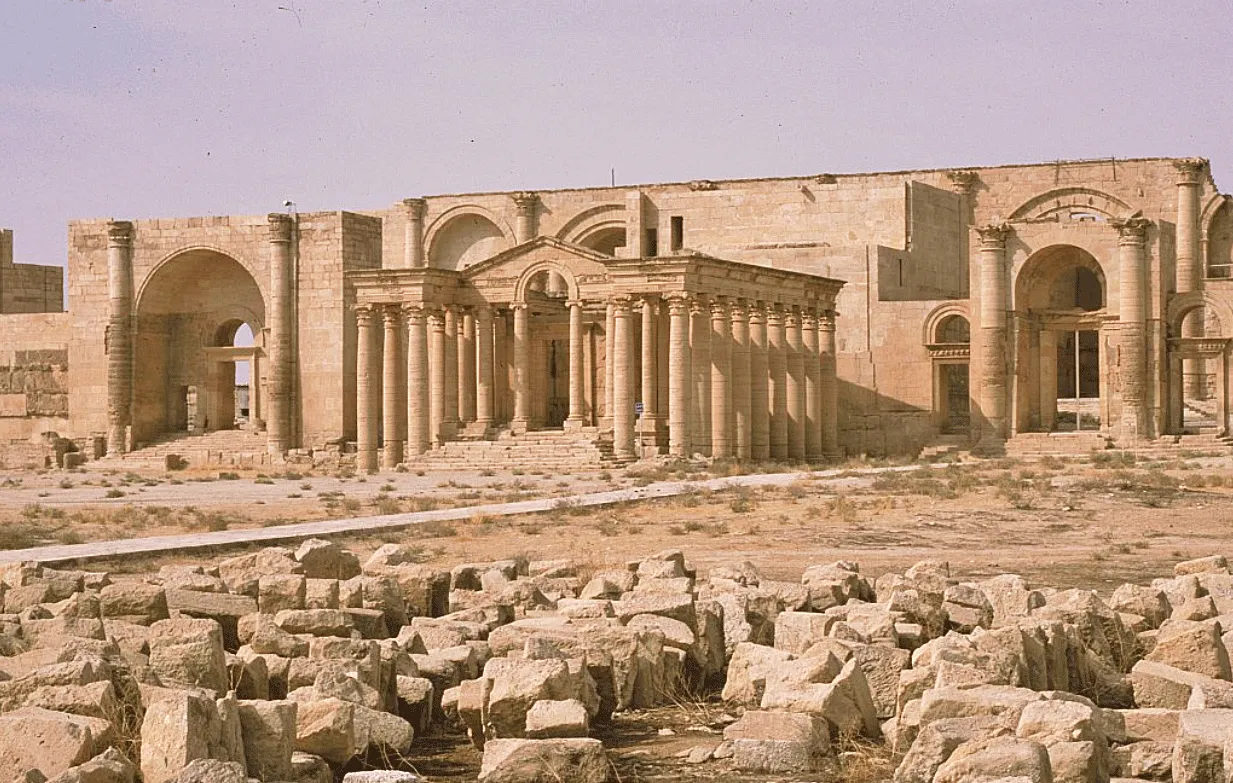
Out in the desert of the Nineveh Plains, forty minutes from the modern road, the sun temple city of Hatra rises from the sand. Twice the Roman legions besieged it. Twice they marched away with nothing. For three centuries this circular city of the Parthian world stood as the frontier between two empires, and it remains the best-preserved fortified city of antiquity anywhere in the region.
Hatra was founded in the 3rd or 2nd century BCE as the capital of the Kingdom of Hatra, a semi-autonomous Arab kingdom within the Parthian Empire. At its peak the city held approximately 30,000 inhabitants. Its circular wall, approximately 6 kilometres in circumference, enclosed a grid of streets, temples, and residences. The city's wealth came from its position on the trade route between the Parthian and Roman empires, and from its role as a religious center dedicated to the sun god Shamash and the goddess Shahiro.
The Roman Sieges
The Roman Emperor Trajan besieged Hatra in 116 CE and failed. The Emperor Septimius Severus besieged it again in 198 and 199 CE, and failed twice. The Roman accounts describe the defenders' use ofGreek fire, a precursor to napalm, launched from the walls. The city's double wall system, its water supply from underground cisterns, and its position in the open desert made it nearly impossible to take by force. Hatra held out against Rome for three centuries, a feat matched by few cities in the ancient world.
The Great Iwans
Walking through the Great Iwans, the colossal arched halls that still stand to their full height, you feel the scale of the place. The East Iwan, the largest, rises to approximately 30 metres, with a span of 25 metres. The stucco decorations on the interior walls depict gods, kings, and mythological creatures in a style that blends Greek, Roman, and Parthian influences. The South Iwan faces the great temple of Shamash. These are not ruins in the usual sense. They are architecture that has simply outlived its builders.
Hatra and the Goddess Shahiro
The old temples of Hatra honoured Shahiro, the Lady of the First Light, the dawn that breaks over the northern plains. Her image, painted in gold and lapis, kept watch over the city's thresholds. The guide's grandmother told him the old story: even in the desert, the light always returns. Shahiro's temple was one of the most important in the city, and her worship was central to Hatran religion. The blending of Mesopotamian, Greek, and Parthian religious traditions at Hatra is one of the things that makes the city archaeologically significant. It reveals a culture that was not simply a satellite of Rome or Parthia, but a distinct civilization with its own gods, its own art, and its own way of life.
Preservation and Conflict
Hatra was inscribed as a UNESCO World Heritage Site in 1985. The work of preservation has been ongoing, interrupted by conflict. In 2015 ISIS damaged the site, destroying sculptures and defacing reliefs. After liberation in 2017, conservation efforts resumed. The site is now accessible to tourists, and the work of preservation continues. Visiting is not only safe, it is a way of standing with that work.
Practical Notes
- Access: Hatra is a full-day excursion from Mosul (approximately 110 km, 2 hours) or Erbil (approximately 200 km, 3 hours). It is included in the Northern Odyssey, Iraq Grand Journey, and UNESCO Heritage tours.
- Entry fee: IQD 25,000 for foreigners, IQD 3,000 for Iraqis.
- Best light: Late afternoon, when the ochre stone glows against the desert sky. The morning light is also good for photographs of the East Iwan.
- Carry: Water, a hat, sunscreen. The site is exposed with no shade. The walking distance between the main iwans is approximately 1.5 km.
- Combine with: Mosul's Old City (2 hours south), the Al-Nouri Mosque, and Hosh al-Bie'a. The Northern Odyssey pairs Hatra with Mosul in a multi-day northern circuit.