On a plain between Najaf and the Euphrates, seventy-two men stood against an army of four thousand. What happened there changed the course of a faith.
The Road Between Two Shrines
The road from Najaf to Karbala is approximately 130 kilometres, a drive of about ninety minutes through the flat alluvial plain of southern Iraq. The landscape does not change. The road does not curve. The sky is enormous. This is the same plain that Husayn ibn Ali crossed in the year 61 AH (680 CE), when his caravan of roughly seventy men, family members, companions, children, was intercepted by an Umayyad army that would grow to four thousand. The plain has not forgotten. The people who live along this road have not forgotten. Every building, every market stall, every conversation in a roadside café carries the memory.
Between Najaf and Karbala the first stop is Khan al-Waqf, a historic caravanserai built during the Ottoman era to shelter Iranian pilgrims traveling between the two holy cities. It was funded by Muhammad Hussein Khan, described as the "Amir of the State of the King of Persia." The caravanserai is being restored as part of Iraq's post-ISIS heritage recovery. Its large square plan, surrounding an open courtyard with covered riwaqs on all four sides, could once accommodate a thousand people. Traveler James Silk Buckingham described it as having excellent stables, elevated sleeping platforms in arched alcoves for winter, and open-air rooms for summer. The khan is a reminder that this road has been walked by pilgrims for centuries, that the route between Najaf and Karbala is one of the oldest continuously traveled religious paths in the world.
The Tenth of Muharram
The Battle of Karbala took place on 10 Muharram 61 AH, 10 October 680 CE. Husayn ibn Ali, the grandson of the Prophet Muhammad and the third Shia Imam, had refused to pledge allegiance to Yazid I, the second Umayyad caliph, whose rule Husayn viewed as illegitimate. He traveled toward Kufa, where Shia sympathizers had invited him. His caravan was intercepted by an initial force of one thousand Umayyad soldiers, then surrounded by a larger army of four thousand under the command of Ubayd Allah ibn Ziyad, the governor of Basra.
Husayn was denied access to the Euphrates River. Water was cut off for three days. On the tenth of Muharram, a day that would become known as Ashura, battle was joined. Husayn was killed, along with most of his male relatives and companions. His surviving family, women and children including his son Ali Zayn al-Abidin who was too ill to fight, were taken prisoner and marched to Damascus. The refusal to pledge allegiance, and the willingness to die for that refusal, became the defining act of Shia identity: the eternal struggle between justice and tyranny, between conscience and power.
The Shrine of Imam Hussein
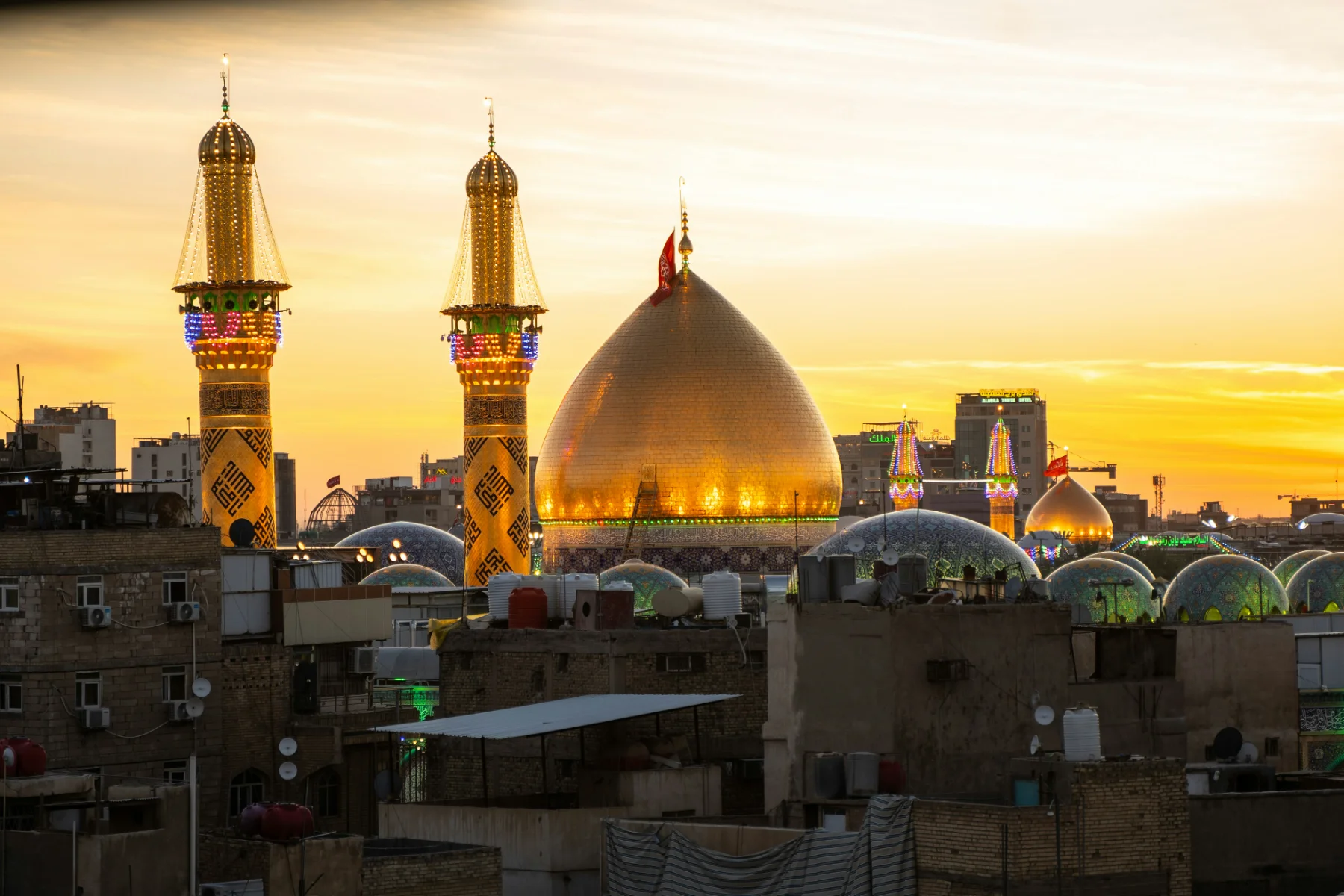
The first structure over Husayn's grave was built by al-Mukhtar ibn Ubayda al-Thaqafi in 65 AH (684 CE), just four years after the battle. The Abbasid caliphs destroyed it twice. Harun al-Rashid ordered it demolished in 786 CE. Al-Mutawakkil razed it again in 847 CE, plowing the site and cultivating it to erase all traces. Each time it was rebuilt. The present architectural foundation dates to the Buyid ruler Adud al-Dawla, who reconstructed the shrine between 977 and 982 CE. The golden dome, twenty-seven metres high and completely covered in gold, was gilded by Agha Mohammad Khan Qajar in 1796 CE, after the 1801 Wahhabi attack that destroyed the previous dome and zarih.
The current zarih, the hexagonal lattice enclosure over the tomb, was installed on 5 March 2013, built in Qom, Iran. It covers approximately thirty-four square metres with twenty windows. Its materials: 118 kilograms of gold, four tons of silver, two tons of copper, 1,300 kilograms of brass, and five tons of Burmese teak wood. Total weight: approximately twelve tons. The shrine complex measures fifty-nine by seventy-five metres, with ten gates and approximately sixty-five decorated rooms. Inside are the graves of Husayn ibn Ali, Habib ibn Madhahir al-Asadi, and the seventy-two martyrs of Karbala.
Abbas, the Brother Who Would Not Stop
Three hundred and seventy-eight metres northeast of the Imam Husayn Shrine, connected by the large plaza known as Bayn al-Haramayn ("Between the Two Shrines"), stands the shrine of Abu al-Fadl al-Abbas. Abbas ibn Ali was the son of Ali ibn Abi Talib and Fatimah al-Uzma bint Hizam, half-brother of Hasan and Husayn. At Karbala he was Husayn's flag-bearer and chief of the caravan. His task was to fetch water from the Euphrates for Husayn's thirsty children. He reached the river. He filled the waterskins. On the return he was ambushed. Both hands were severed, a detail so specific, so visceral, that the shrine complex includes two maqams marking where each hand fell: Al-Kaf al-Ayman (the right hand) and Al-Kaf al-Aysar (the left hand). Abbas was killed near the Alqamah Canal and buried where he fell. Over centuries the Euphrates changed course and now flows around the Abbas shrine. It is said that the river came to him.
The shrine's golden dome was completed in 1955. The silver zarih installed in 1966 was crafted by master artisans from Isfahan, incorporating 400,000 mithqals of pure silver and 8,000 mithqals of gold, requiring three years to complete. In April 2016 this was replaced with a new zarih, the first to be completely built in Iraq by Iraqi craftsmen. Four symmetrical riwaqs with mirror mosaics line the interior. A large enameled golden door made in Isfahan marks the southern entrance.
The Fortress and the Church
South of Karbala, about fifty kilometres into the desert, stands Al-Ukhaidir, one of Iraq's most impressive early Islamic fortresses. Built in 775 CE by Isa ibn Musa, nephew of the first Abbasid caliph, its massive rectangular walls enclose a palace complex with a large Iwan, a reception hall, servants' quarters, and a mosque. The fortress introduced an innovative construction technique: elliptical barrel vaults built with bricks in a method similar to wall construction, replacing the older technique of mortar and debris on wooden frameworks. Gertrude Bell wrote the first major archaeological report on the site in the early twentieth century. The fortress is on the UNESCO World Heritage Tentative List.
Nearby, Al-Qusayr Church, one of the remarkable Christian heritage sites around Karbala, creates a striking contrast within the same day: the story of Karbala alongside Iraq's ancient Christian heritage. The coexistence of these traditions in the same landscape is one of the things that makes southern Iraq unlike anywhere else.
Practical Notes
- Access: Karbala is approximately 130 km from Najaf and 100 km from Baghdad. The Ziyarat and Heritage, Heart of Iraq tour covers both cities. The Mesopotamia Odyssey includes Karbala as a day trip from Najaf.
- Dress: Modest clothing required. Women must cover their hair. Black clothing is traditional during Muharram but not required at other times.
- Timing: The shrines are open twenty-four hours. Ashura (10 Muharram) and Arbaeen (40 days after Ashura) draw millions of pilgrims, the largest peaceful gatherings on earth.
- Combine with: Al-Ukhaidir Fortress and Al-Qusayr Church are half-day excursions from Karbala, included in the Ziyarat and Heritage and Southern Adventure itineraries.