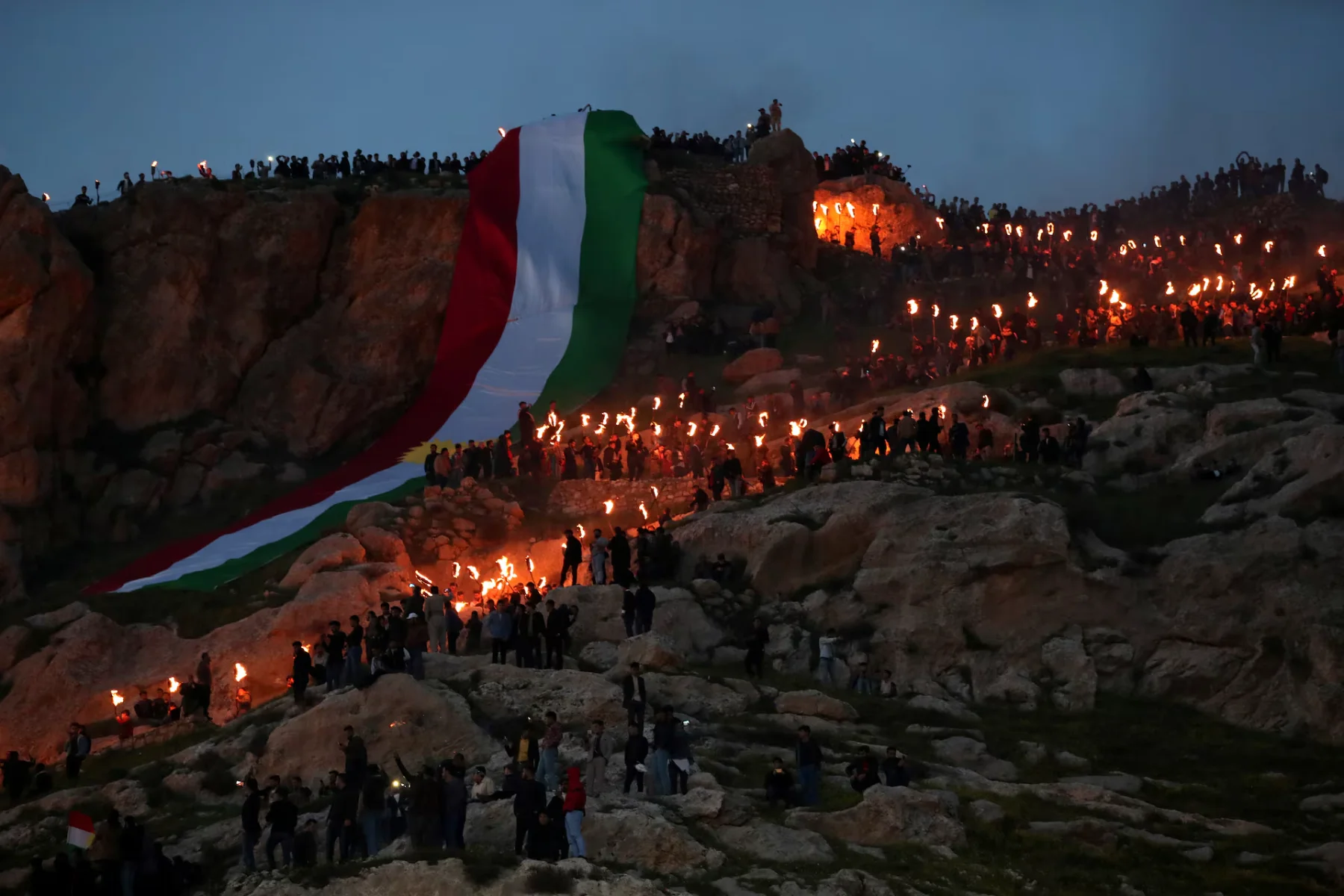
On the evening of 20 March, the hills of Kurdistan light up. Bonfires, circle dances, and a celebration that has survived three thousand years of empire, suppression, and war.
The Night the Fires Light
On the evening of 20 March, the hills of Kurdistan catch fire. Not in destruction. In celebration. The Kurds call it Chwarshama Soor, Red Wednesday, the lighting of the bonfires that mark the beginning of Nowruz, the Kurdish New Year. It falls on the spring equinox, when day and night are equal in length, and it has been celebrated for over three thousand years. The fires symbolize the passing of winter, the defeat of darkness, and the return of light. In Zoroastrian tradition, fire is purification. In Kurdish tradition, it is freedom. The two have been the same thing for longer than most nations have existed.
The word Nowruz means "new day." It comes from the Persian nav (new) and ruz (day). The Kurdish calendar date is the 1st of Khakalewa, which falls on the 19th, 20th, or 21st of March. Celebrations typically span 18 to 24 March. Schools close. Work stops for three days. The bazaars sell out of traditional Kurdish clothes: wide flappy trousers called shal u shapik for men, sparkling ankle-length satin gowns in bright colors for women. Government officials and political leaders wear traditional dress, including the red-and-white Kurdish scarf. The entire country shifts into festival mode.
The Legend of Kawa
Every celebration needs a story, and Nowruz has one that the Kurds have told for three thousand years. The story goes like this. Zuhak, an evil Assyrian king with serpents growing from his shoulders, ruled Kurdistan for a thousand years. His tyranny was so complete that spring no longer came. Two young men were sacrificed daily to feed his serpents. The land was barren. The people were starving. Then came Kawa, a blacksmith who had lost six sons to Zuhak. Kawa led a revolt. He killed Zuhak with his hammer. He lit fires on the hillsides to celebrate victory and summon supporters. Spring returned the next day. The fires of Nowruz remember that moment. Every bonfire lit on 20 March is Kawa's fire, rekindled. Every flame is a refusal to let tyranny have the last word.
The Govend, the Circle Dance
The govend is the great communal dance of the Kurds. Men and women link hands or arms and move as one in a circle, semicircle, or long line. A serchopi, a leader, stands at the head of the line and waves a handkerchief or scarf to guide the rhythm. The dance is accompanied by the daf, a frame drum, the davul, a great drum, and the zurna, a double-reed wind instrument. The sound is unmistakable: the deep thud of the davul, the sharp cry of the zurna, and the rhythmic shuffling of feet on earth. Dancing the govend around the bonfire is the iconic image of Nowruz in Kurdistan.
The fact that men and women dance together is significant. In much of the region, public gatherings are gender-separated. In Kurdistan, the govend is mixed. This is not a modern concession. It is an ancient tradition. The dance is an expression of Kurdish identity, and Kurdish identity includes the presence of women in public life. In times when Kurdish identity and culture have been suppressed, the simple act of gathering to dance the govend has taken on the character of quiet resistance, an assertion of who the Kurds are.
Where to Celebrate
Akre, the Most Iconic
Akre, about an hour and fifteen minutes from Erbil, holds the single most spectacular Nowruz celebration in all of Kurdistan. On the evening of 20 March, youths with fire torches file up the mountainside in a jagged fire walk, lighting a giant bonfire at the top while a Kurdish flag is simultaneously lowered down the mountain. The steep alleys of the old city fill with fireworks, food stalls, and dancing. High-ranking officials give speeches. The image of the fire walk at Akre has become the defining photograph of Kurdish Nowruz. If you can only go to one place, go to Akre.
Erbil, the Most Accessible
Erbil is the most tourist-ready city in Kurdistan. The Citadel and Park-e Shahnadar host large public gatherings with fire-lighting, dancing, and artistic performances. The bazaar empties its stalls of traditional Kurdish clothes. All inhabitants, young, old, male, female, Sunni and Christian, leave their homes and their political divisions behind to gather, dance, and sing around a central fire. Erbil is the easiest place for a first-time visitor to experience Nowruz.
Sulaymaniyah, the Most Relaxed
Kurdistan's cultural and intellectual heart. People gather on Mam Jalal Hill holding the Kawa the Blacksmith flame. Grand public celebrations feature artistic and cultural performances. Sulaymaniyah has a strong cafe culture and the Amna Suraka museum documenting Saddam-era persecution. The city is generally considered the most relaxed and welcoming in Kurdistan.
The Mountains
The Zagros foothills erupt with wildflowers by late March. The mountain valleys around Rawanduz, the Hamilton Road, and the waterfalls at Bekhal and Gali Ali Beg are scenic Nowruz destinations. Celebrations spread across hillsides where families light bonfires and picnic. The landscape itself becomes part of the celebration: fire dots the green slopes like stars brought to earth.
The Yazidi New Year at Lalish
Within the same season, the Yazidi community celebrates its own New Year, called Charsama Sor, Red Wednesday, or Sersal. It falls on the first Wednesday on or after 14 April, following Kurdish Nowruz. The celebration takes place at Lalish, the holiest site in the Yazidi faith, a temple complex in the mountains of Duhok province that dates back approximately four thousand years. 365 candles are lit, representing the days of the year. Religious ceremonies are led by the Baba Sheikh. Qawwals, religious singers, recite hymns accompanied by flums and tambours. Pilgrims climb the hills surrounding Lalish and fasten colorful ribbons to wishing trees. Colored eggs are boiled and hung above doorways. The sacred Zemzem spring, in a dark cave, is visited. Bonfires are lit at night. The hekkane game, egg tapping, is played, the cracking of the egg symbolizing the bursting of the primordial White Pearl. Lalish is open to respectful visitors. Dress modestly, remove shoes before entering temples, and ask permission before photographing ceremonies.
Why Nowruz Was Forbidden
Under Saddam Hussein's regime, Nowruz celebrations were banned or severely restricted. The Baath Party viewed Kurdish cultural gatherings as potential rallying points for separatism. The lighting of fires, the wearing of traditional clothes, the dancing of the govend, all were acts that could bring trouble. Kurds celebrated anyway, in private, in remote villages, in the mountains. The tradition survived because it was too deeply rooted to destroy. After the fall of Saddam in 2003, Nowruz returned to public life with enormous force. The first open celebrations drew hundreds of thousands. Today, Nowruz is an official holiday in the Kurdistan Region, and the celebrations are among the largest in the Middle East.
In March 2022, a bombing at a Nowruz gathering in Erbil killed three people and injured several others. The attack was widely condemned. The Kurds lit their fires anyway. The tradition of Nowruz is, at its core, a tradition of refusal: refusal to let darkness win, refusal to let tyranny have the last word, refusal to stop celebrating the arrival of spring. Three thousand years of empire have not ended it. A bomb did not end it. The fires still light on the evening of 20 March.
Practical Notes
- Dates: Nowruz falls on or around 21 March. Celebrations span 18 to 24 March. The main fire-lighting is on the evening of 20 March. Schools and government offices close for three days.
- Access: Erbil International Airport is the main gateway. Direct flights from Dubai, Istanbul, London. Akre is 1 hour 15 minutes from Erbil by car. Sulaymaniyah is 3 hours from Erbil.
- What to wear: Traditional Kurdish clothes are available in the bazaars and are warmly received. Modest, comfortable clothing is also fine. The celebrations are family events.
- Safety: The 2022 bombing was an isolated incident. Security around Nowruz celebrations is now extensive. Kurdistan is the safest region in Iraq for tourists.
- Combine with: The Iraqi Kurdistan Trek and Northern Odyssey tours can be timed to coincide with Nowruz. The UNESCO Heritage expedition also runs in the spring window.