Stand before the resting place of Imam Ali as the evening light turns the dome to gold, and walk through the largest cemetery the world has ever known.
The First Light on the Dome
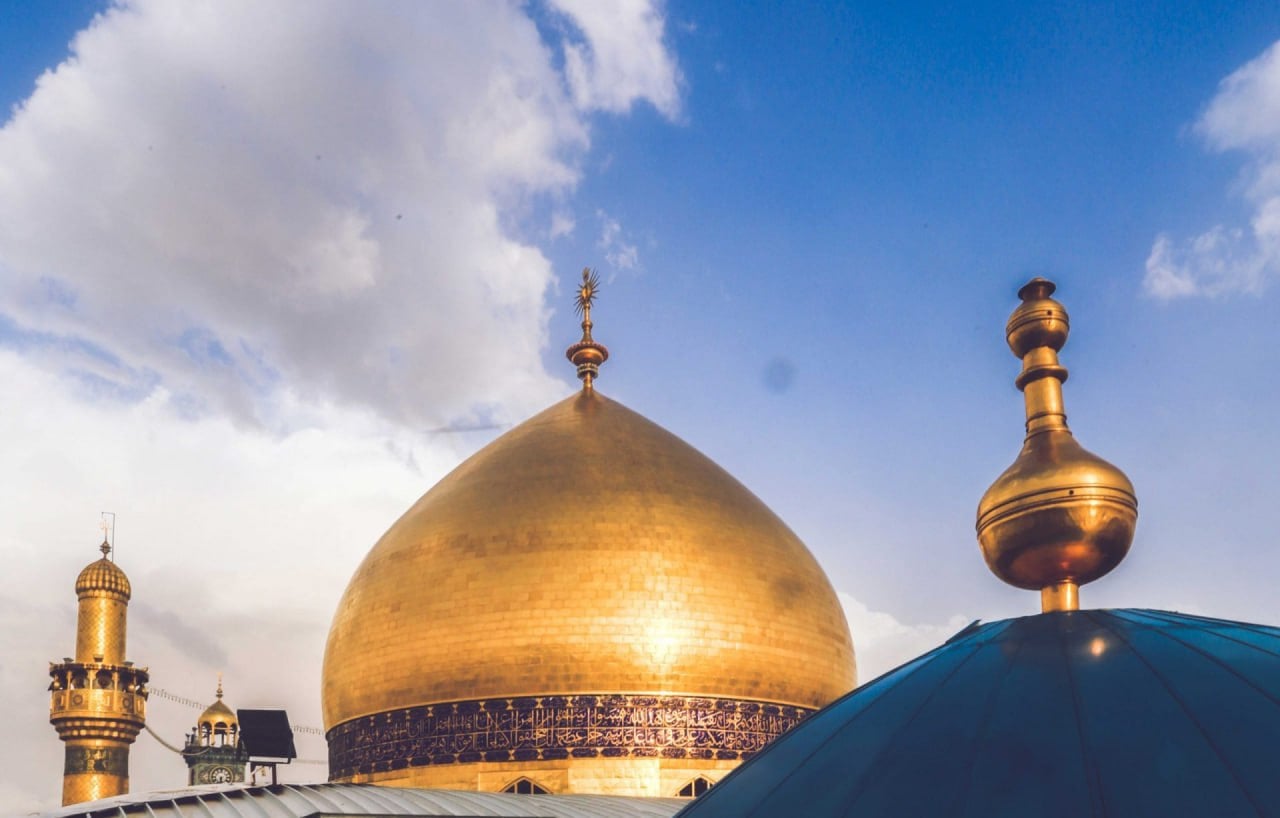
There is a moment just before sunset when the dome of the Imam Ali Shrine does something no photograph can capture. The gold does not reflect the light. It seems to generate it. The 3,426 gilded copper panels that coat the dome each hold approximately eight mithqals of pure gold, and in the last hour of the day the entire structure becomes a second sun above the rooftops of Najaf. Pilgrims who have traveled from London, from Detroit, from Kuala Lumpur stand in the courtyard and watch it happen. Some weep. Most simply stand.
This is not a monument. It is the resting place of Ali ibn Abi Talib, the cousin and son-in-law of the Prophet Muhammad, the first Shia Imam, the fourth caliph of Islam. For Shia Muslims this is the holiest site on earth after Mecca, Medina, and Al-Aqsa. The first shrine was commissioned by the Abbasid Caliph Harun al-Rashid around 786 CE, after the discovery of Ali's burial site. What stands today dates largely to the Safavid period, designed by the polymath Sheikh Baha'i in the seventeenth century, and gilded on the orders of Nader Shah Afshar in 1743 at a cost of ten thousand tomans.
The Dome Itself
The dome is a double-shell structure. An inner onion dome rises forty-two metres above the tomb chamber. An outer shell dominates the Najaf skyline at sixteen metres from base to finial. The inner shell is visible from inside the tomb. The outer shell is what you see from across the city. Between the two shells the structure is an engineering achievement that has survived earthquakes, fires, and the deliberate destruction of invading armies.
Flanking the Golden Iwan, the rectangular open-air hall on the eastern side with walls entirely covered in gold, stand twin minarets rising thirty-eight metres, bearing inscriptions from Surah al-Jumu'ah. The shrine complex covers approximately 13,244 square metres. The main courtyard, where pilgrims gather for evening prayers, spans 4,219 square metres of marble flooring donated by the Isma'ili community. Mirror mosaics line the interior walls. Ceramic tilework from the eighteenth and nineteenth centuries covers the lower surfaces. The zarih, the ornate cage-like enclosure over the tomb itself, has been donated and rebuilt by various patrons over centuries.
Wadi al-Salam, the Valley of Peace
Behind the shrine, stretching to the horizon in every direction, lies the largest cemetery in the world. Wadi al-Salam, the Valley of Peace, covers 601 hectares, thirteen percent of the city of Najaf. More than six million bodies are buried here. Fifty thousand new burials are added each year, from every country where Shia Muslims live. The cemetery has been in continuous use for over 1,400 years, the only burial ground on earth with that record.
Shia tradition holds that Ali himself declared Wadi al-Salam to be part of heaven. The belief is that those buried here will be raised from the dead on Judgment Day with their spiritual leader. Religious edicts from senior Shia scholars encourage burial in Wadi al-Salam, and the cemetery's expansion reflects what scholars describe as Shia Islam's more permissive attitude toward the commemoration of the dead and the erection of mausoleums. The graves stretch across the desert in every direction. Some are marked with elaborate marble structures. Others with simple stones. Among the notable burials: Grand Ayatollah Muhammad Baqir al-Sadr, executed by Saddam's regime in 1980. Grand Ayatollah Muhammad Sadiq al-Sadr, one of the most visited tombs. And, according to Shia tradition, the prophets Hud and Salih.
Walking through Wadi al-Salam is not like walking through a cemetery. It is like walking through a city of the dead, a landscape so vast that the horizon disappears behind headstones. The silence is profound. The scale is impossible to hold in the mind.
The Bazaar
Step away from the shrine and the cemetery and you enter the Najaf Grand Bazaar, the oldest market in the city, officially opened by Shah Abbas the Great in 1623 CE when he visited Najaf and renamed it "The Great Street." The bazaar stretches approximately 550 metres, with eight specialized branches on both sides: the goldsmith market, the spice market, the perfume market, the butchers' market, the fabric market. It is the economic nerve of Najaf, where pilgrims shop after visiting the shrine. Gold jewelry, religious books, traditional Iraqi sweets like daheen (made from flour, ghee, walnuts, and buffalo cream), perfumes, abayas. The covered alleys are narrow. The light is filtered through metal roofing. The sound of bargaining mixes with the call to prayer from the shrine.
The Mosque of Kufa, Where It All Ended
Twenty minutes south of Najaf, in the city of Kufa, stands one of the oldest surviving mosques in the world. The Great Mosque of Kufa was built in 638 CE, the same year as the city itself. Ali ibn Abi Talib made Kufa his capital, and it was here, on 28 January 661 CE, while prostrating in the dawn prayer, that he was struck by a poison-coated sword wielded by Abd al-Rahman ibn Muljam, a Kharijite. Ali died of his wounds two days later. The mihrab where he fell is still marked inside the mosque. So is the place where he was washed and shrouded.
The mosque covers 11,000 square metres, a quadrangular layout of approximately 109 by 110 metres, with four minarets, two domes, and three shrines inside: Muslim ibn Aqeel (Ali's nephew and Imam Hussein's envoy to Kufa), Hani ibn Urwa, and al-Mukhtar. Shia tradition holds that one obligatory prayer in this mosque equals one thousand prayers elsewhere, and that sitting here without praying is itself a form of worship.
Adjacent to the mosque stands the shrine of Muslim ibn Aqeel, the cousin of Imam Hussein who was sent to Kufa to rally support before the Battle of Karbala. The people of Kufa pledged their loyalty, then withdrew it under pressure. Muslim was killed on 9 Dhul Hijjah 60 AH (18 September 680 CE). His burial site was intended to prevent visitation. Guards were posted. But Shia Muslims continued visiting, first secretly at night, then openly. The shrine's gilt dome covers the spot where he was buried.
The House of Imam Ali
Near the mosque, in the area called Rahabat Ali, stands the house where Imam Ali lived with his family. When he became caliph and moved from Medina to Kufa, he refused to reside in the Governor's Palace. Instead he built a modest house of mud and stone, connected to the Great Mosque through a small door in the qibla wall known as Bab al-Sudda. This is where he spent his last years, administering affairs, delivering sermons, guiding followers. The house is simple. That is the point. It was built by a man who could have lived in a palace and chose not to.
Al-Sahla Mosque, the Evening Visit
As the sun goes down, the road from Kufa leads to Al-Sahla Mosque, one of the most spiritually significant mosques in Shia tradition, deeply associated with Imam al-Mahdi. The evening atmosphere at Al-Sahla is unlike the daytime energy of the shrine in Najaf. The courtyard is quieter. The light is softer. The sense of anticipation, of waiting for something that has not yet arrived, is part of the experience. The mosque is spacious, with a large courtyard and multiple prayer halls. Shia tradition holds that Imam al-Mahdi will reappear here.
Practical Notes
- Access: Najaf is approximately 160 km south of Baghdad (about 2 hours by car). Najaf International Airport receives domestic flights. The Ziyarat and Heritage, Heart of Iraq tour begins and ends in Najaf.
- Dress: Modest clothing is required at all shrines. Women must wear a headscarf. Abayas are available at the shrine entrance for those who need them.
- Timing: The shrine is open twenty-four hours. The best light for the dome is the hour before sunset. Wadi al-Salam is accessible during daylight hours.
- Combine with: The Great Mosque of Kufa, the House of Imam Ali, and Al-Sahla Mosque are all within a thirty-minute drive of Najaf and are included in the Southern Adventure and Ziyarat and Heritage itineraries.